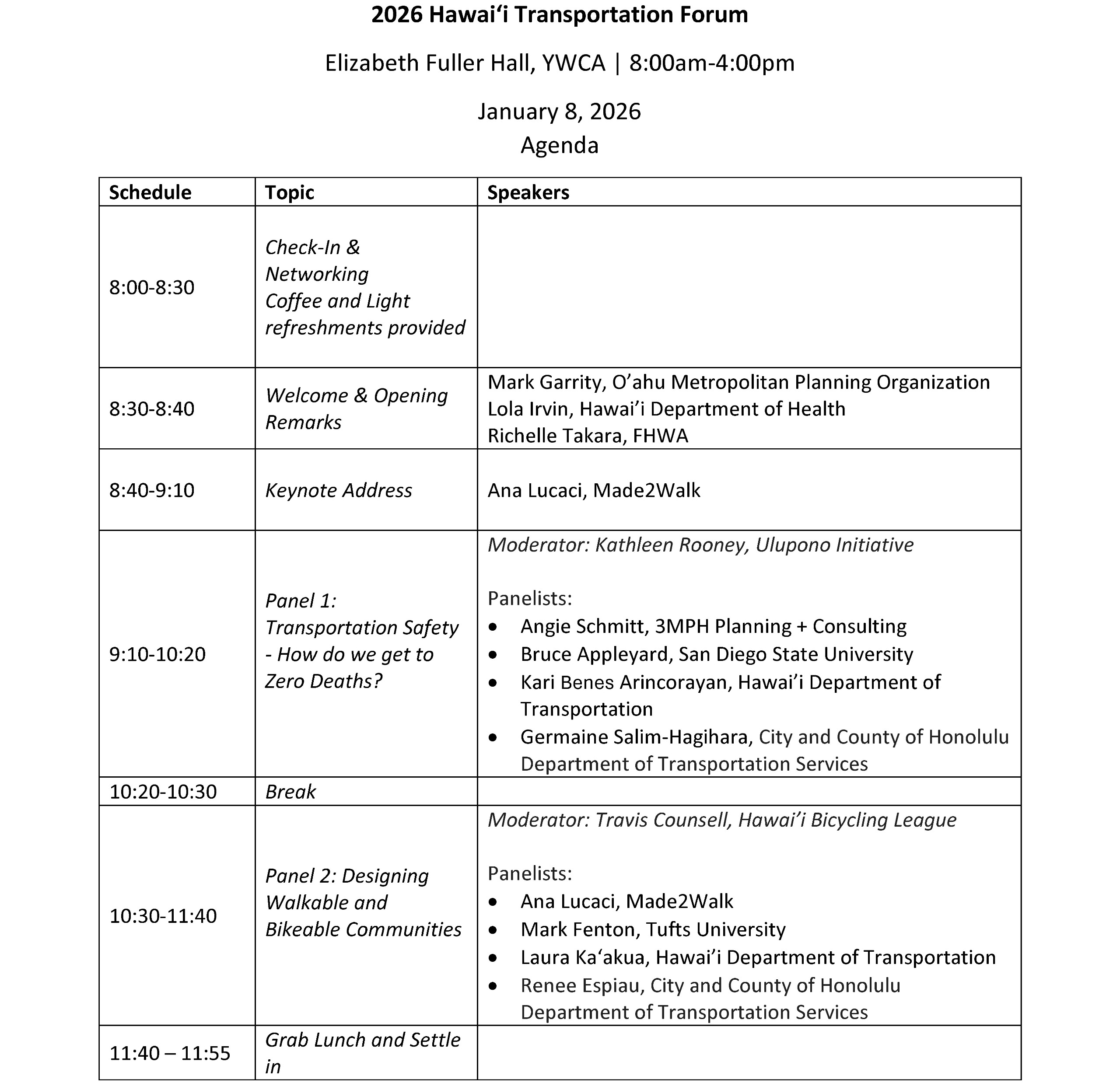
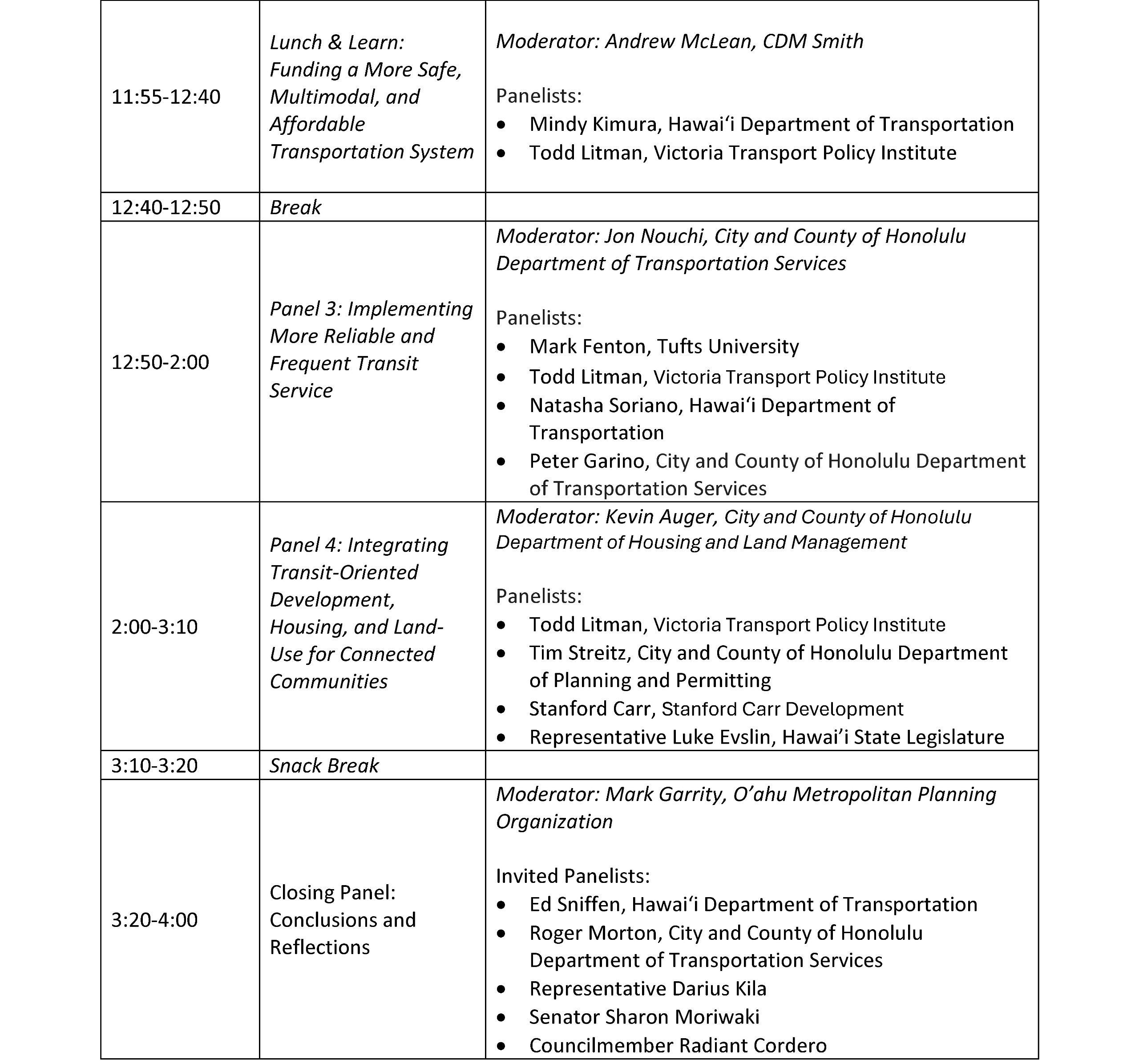
agenda
agenda

Description of Topics

The forum is organized around a series of focused panels that examine Hawaiʻi’s most pressing transportation challenges and opportunities. These sessions explore strategies to improve safety, expand walking, biking, and transit options, secure sustainable funding, and deliver reliable, equitable transportation systems.

Panel 1

Transportation Safety - How do we get to Zero?

This panel opens the forum by grounding participants in the most urgent challenge facing Hawaiʻi’s transportation system: safety. With 2025 being the deadliest years on Hawaiʻi’s roads since 2007, speakers will explore national trends, statewide data, and proven design, policy, and strategies to reduce traffic deaths, serious injuries, and hospitalizations. National and local experts will discuss how effective approaches from other regions can be translated into actionable solutions for Hawaiʻi.

Panel 2

Designing for Walkable and Bikeable Communities

This panel will explore how active transportation contributes to safer, healthier, and more connected communities across Hawai‘i. Speakers will highlight strategies to expand walking, biking, rolling, and transit access, infrastructure, and services; showcase successful community engagement and network design practices; and discuss how to align policy, and infrastructure investments to support multimodal travel. The session aims to inspire practical, scalable solutions that increase transportation choices, improve quality of life, and advance statewide requirements and goals for equity, sustainability, and mobility.

Lunch & Learn

Funding a More Safe, Multimodal, and Affordable Transportation System

This panel will examine how Hawai‘i can sustainably fund a safer, more multimodal, and more affordable transportation system. Speakers will highlight the range of funding mechanisms available at the state and national levels and discuss how strategic investment can improve safety, improve active and public transportation, reduce automobile dependence, and reduce transportation costs for residents. The session will also share proven strategies and inspire actionable pathways for creating a resilient and financially sustainable transportation future for Hawai‘i.

Panel 3

Implementing More Reliable and Frequent Transit Service

This panel will explore strategies to implement more reliable and frequent transit service in Hawai‘i. Speakers will highlight the benefits of efficient, reliable, and frequent transit service for public health, safety, and mobility, examine statewide transit priorities, and share national and local best practices for creating seamless, efficient transit networks. The session will demonstrate how coordinated planning and service design can increase ridership, reduce congestion, enhance equity, improve residents’ quality of life, and support a sustainable and connected transportation system.

Panel 4

Integrating TOD, Housing, and Land-Use for Connected Communities

This panel will examine how transit-oriented development, housing, and land-use planning, policies, permitting, and zoning can work together to create more accessible, sustainable, and connected communities in Hawai‘i. Panelists will explore how TOD can increase transportation choices, support affordable housing initiatives, reduce residents’ transportation costs, and improve residents’ quality of life. The session will feature perspectives from national experts, a private developer, a State legislator, and a City and County of Honolulu official on strategies to promote higher density, mixed-use, and affordable development near transit, improve equity, and encourage infill development. Participants will gain insights into the challenges and opportunities of integrating transit, land use, and housing to foster vibrant and livable communities, as well as meet other key state and county climate and affordability commitments.


Invited Speakers

The forum convenes local leaders, subject-matter experts, and guest speakers to exchange ideas and help shape strategies for success. A full list of invited speakers and biographies is provided below.

National Experts

  • ​Angie Schmitt

    Angie is one of the country's best-known writers and experts on the topic of sustainable transportation. She was the long-time national editor at Streetsblog. Her writing and commentary have appeared in the New York Times, The Atlantic, and National Public Radio. She is the founder and principal at 3MPH Planning and Consulting, a small firm focused on pedestrian safety. She lives in Cleveland with her husband and two children.

  • Ana Lucaci

    Ana is an advocate and public health professional pursuing PhD in Transportation Engineering at the University of New Mexico, focusing on pedestrian and bicyclist safety. She is passionate about making walking and rolling accessible and safe and is the founder of Made2Walk, a Walk2Connect trainer, and a former Walking College mentor. With 15+ years of experience in public health and engineering, she brings expertise in community engagement, program development, and cross-sector collaboration.

  • Bruce Appleyard

    Dr. Appleyard is an Associate Professor of Urban Design and City Planning at San Diego State University. He specializes in applied research of human settlement and behavior patterns at the intersection of urban design, transportation, land use, environmental science & policy. His work focuses on how policies and practices can be used in concert with one another to improve a range of sustainability, livability, and social equity, outcomes.

  • Mark Fenton

    Mark is a nationally recognized public health, planning, and transportation consultant, associate professor at Tufts University, advocate for active transportation, and former host of “America’s Walking” on PBS television. He has led training and planning processes for pedestrian-, bicycle-, and transit-friendly designs in communities across the US, Canada, and Australia. He studied engineering at the Massachusetts Institute Technology and biomechanics at the US Olympic Training Center.

  • Todd Litman

    Todd is the founder and executive director of the Victoria Transport Policy Institute, an independent research organization dedicated to developing innovative solutions to transport problems. His work helps expand the range of impacts and options considered in transportation decision-making, improve evaluation methods, and make specialized technical concepts accessible to a larger audience. His research is used worldwide in transport planning and policy analysis.

Local Experts

  • Andrew McLean

    Andrew is a Transportation Policy Specialist at CDM Smith, providing a variety of transportation advisory services to public transportation agencies and private clients. Prior to joining CDM Smith, Andrew served for eight years as a legislator in the Maine House of Representatives, where he chaired the Joint Standing Committee on Transportation. During this time, he also served in leadership positions with NCSL and CSG, working with the nation’s top transportation lawmakers.

  • Germaine Salim-Hagihara

    Germaine has served in the transportation, energy, and infrastructure development fields for 20 years. She holds a Master of Urban and Regional Planning from the University of Hawaiʻi at Mānoa (2012), and a bachelor of Civil Engineering from the University of Western Australia. Germaine is inspired by creative, inclusive public spaces.

  • Jon Nouchi

    Jon Nouchi serves as the Deputy Director of the City and County of Honolulu’s Department of Transportation Services. He has worked in transportation in Hawaiʻi for 25 years and holds a degree in Urban Planning from the University of Southern California and a certificate in ʻŌlelo Hawaiʻi from the University of Hawaiʻi at Mānoa.

  • Kari Benes Arincorayan

    Kari is a Hawai’i Department of Transportation Highway Safety Manager, Kari leads initiatives that promote safer roadways through data-driven policy, community engagement, and innovative safety programs. Her work focuses on advancing evidence-based solutions through fostering partnerships between government agencies, law enforcement, community stakeholders, and the public to create a culture of safety for all road users.

  • Kathleen Rooney

    Katie is Ulupono Initiative’s lead on transportation-related policy and programs in advancement of cleaner, multi-modal transportation choices in Hawai‘i. Her projects include rightsizing parking policies, helping expand immediate transportation choices and access to those choices at all levels, and electrifying those vehicles that will remain on the road. Katie brings 15+ years of national experience in the transportation and planning to advance community visions and goals.

  • Kevin Auger

    Kevin has four decades of experience in commercial real estate investment banking, capital markets, structured finance, and development. He spent more than a decade in New York City and 15 years in Asia, leading real estate investment programs in senior executive roles with JP Morgan Chase, Lehman Brothers, and Wells Fargo. Since 2012, he has devoted his career to public service and currently serves as Director of the City and County of Honolulu’s Department of Housing and Land Management

  • Laura Ka’akua

    Laura is the Energy Security & Community Outreach Manager at the Hawaiʻi Department of Transportation, overseeing implementation of the Navahine v. HDOT settlement, leading the Energy Security & Waste Reduction Plan, advancing a Native Hawaiian Consultation Policy, and supporting community- and ʻāina-based transportation solutions. Previously, she served as Deputy Director of DLNR, President and CEO of Hawaiʻi Land Trust, and Native Lands Program Manager at Trust for Public Land.

  • Luke Evslin

    Representative Evslin represents Hawaiʻi House District 16 on Kauaʻi. As Chair of the House Committee on Housing, his work focuses on housing policy, including increasing housing supply, reducing barriers to development, and supporting mixed-use and transit-oriented housing. He approaches housing issues with an emphasis on practical solutions that reflect community needs and local context streets for all and expand affordable, sustainable, and fun transportation & recreational opportunities.

  • Mindy Kimura

    Mindy is the Program Manager for the Hawaii Road Usage Charge (HiRUC) Program at the Hawaii Department of Transportation (HDOT). In this role, she oversees the program’s daily operations, including public outreach, stakeholder engagement, policy development, and system implementation. As HDOT’s subject matter expert on RUC, Mindy leads efforts to modernize Hawaii’s transportation funding model and promote long-term sustainability.

  • Natasha Soriano

    Natasha is the Multimodal Transportation Coordinator for the Hawai‘i Department of Transportation, with 15 years of experience in transportation planning, design, and project delivery. She began her career as a design engineer with HDOT, later serving as a transportation planner for the County of Hawai‘i, where she advanced Vision Zero and Complete Streets policies. In her current role, she leads statewide efforts to expand safe, equitable, and sustainable multimodal networks.

  • Peter Garino

    Pete joined the City and County of Honolulu’s Department of Transportation Services in 2022 and serves as Chief of the Performance & Business Analysis Branch. He has 30+ years of transportation experience across rail, bus, ferry, highway, tolling, and aviation. He was Senior Director of Financial Planning at Hawaiian Airlines and COO of the Rhode Island DOT. Pete also held senior roles at NJ TRANSIT and has experience on Capitol Hill. He holds an economics degree from Georgetown University.

  • Renee Espiau

    Renee is the Complete Streets Administrator for the City and County of Honolulu and has supported implementation of the City’s Complete Streets law since 2012. She previously helped establish and manage the City’s Transit-Oriented Development Program. Renee has worked at Project for Public Spaces in New York City and the New Jersey Department of Transportation. She holds degrees from NYU and the University of Oregon and was born and raised on Maui.

  • Stanford Carr

    Stanford S. Carr, President of Stanford Carr Development, LLC, oversees an extensive portfolio ranging from master-planned communities to resort-style homes to affordable rental and for-sale housing. Founded in 1990, SCD has developed over 6k homes throughout its 35-year history and has been recognized with local & national accolades for its communities. Stanford understands his responsibility as a leading developer to create communities that achieve strong market acceptance and long-term value.

  • Tim Streitz

    Tim is the Lead TOD Planner at the City and County of Honolulu's Department of Planning and Permitting, where he plays a pivotal role in shaping sustainable urban environments. He has many years of experience with both current and long-range planning. During his time at the City, he has focused on TOD planning and implementation activities around the island’s Skyline rail stations, which led to new mixed-use zoning, affordable housing policies and incentives, and transportation improvements.

  • Travis Counsell

    Travis is the Executive Director of the Hawai‘i Bicycling League, a nonprofit that enables more people to ride bicycles. Previously, he owned Bikeadelic Hawai‘i, a bicycle rental and tour business in Waikīkī, and earned an MBA from UH Mānoa. In college, he rode his bicycle from Baltimore to San Francisco as a cancer research fundraiser. At HBL, he focuses on building community across stakeholders to create safe streets for all and expand affordable, sustainable, and fun transportation.